MORE TO THINK ABOUT
Home
Starting A Sewing Machine
Servicing Business UK
More Things To Think About
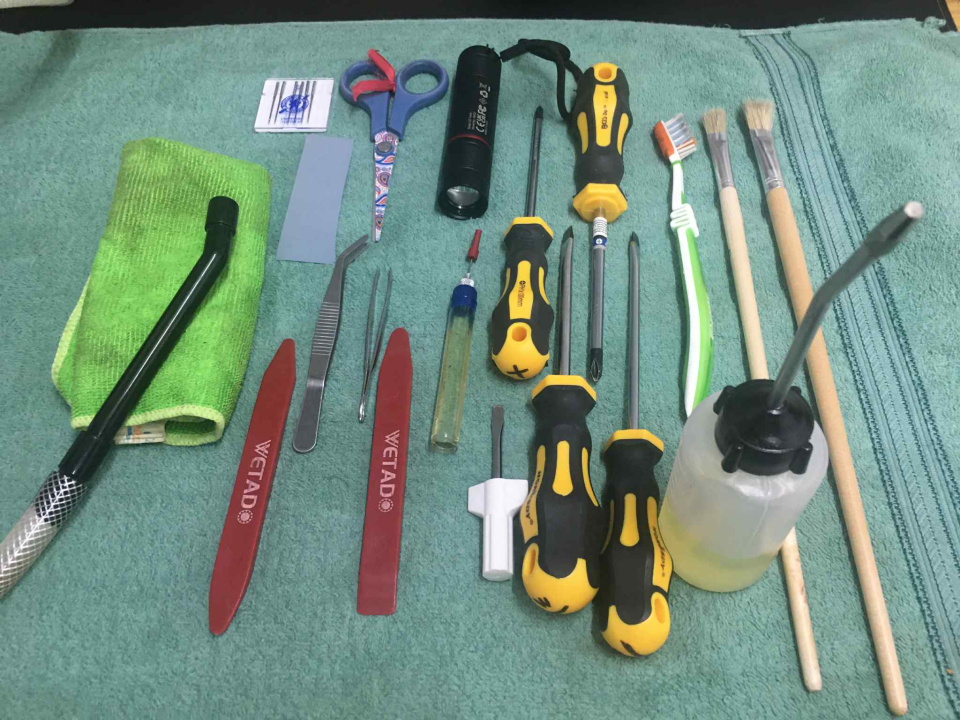
Basic Servicing Tools & Bits
My tools are those recommended in The Sewing Machine Master Guide by Clifford L. Blodget. I now have a lot more, but basically, this is the sort of thing I started with.
From top-left: Good quality Universal needles - I use Schmetz; Sharp scissors; Rechargeable torch to see into those awkward areas; new screwdrivers - I also have a cheap set of driver bits; an old toothbrush; old nylon bristled acrylic brushes; microfibre cleaning cloth - plus a box of tissues; a small piped vacuum; tweasers; a micro-oiler; plastic prying tools; an oiling bottle holding Singer mineral oil.
I also use a pair of very short Phillips and flat head screwdrivers for unscrewing needle plates.
What Machines Will You Service?
In the early days of offering your service, while you are learning, you may want to limit what you work on. In my case, from the outset, I only wanted to do basic domestic sewing machines. This included hand-cranked and electric antique Singer-type models, vintage and newer mechanical or smaller computerised machines. I did not want to get involved with sophisticated computerised sewing machines and embroidery machines, or overlockers, or industrials.
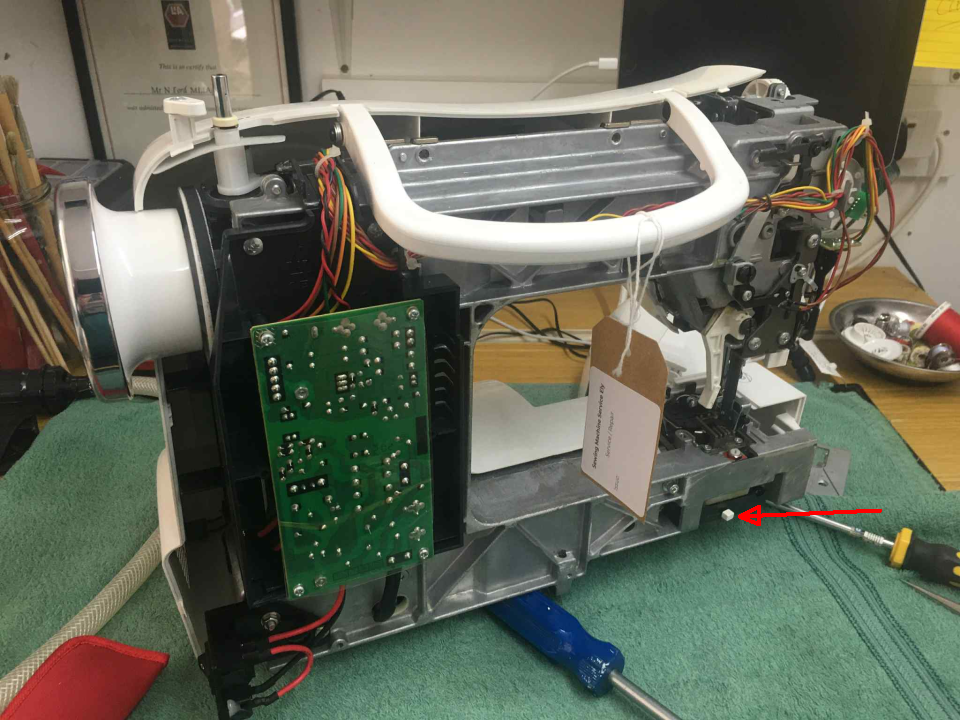
Example Repair:
This Singer is only 3 years old and the customer did not want it serviced but the feed dogs were stuck down. The switch, by the red arrow, was not making any changes, so the side had to come off to see what was going on. It was found that the feed dog height mechanism, controlled by the switch, had become disconnected.
Be Clear With Potential Customers
Your preferences may well be different but I found that by clearly stating what I would and wouldn't do, it avoided wasted calls and frustrated potential customers.
Since I started my machine preferences have not changed mostly because I only have a very small working area, and I don't want to do on-site servicing.
So some of the questions might be:
Which ones won't you do?
Will you collect and return?
Will you work at their homes?
Working On-Site
I have a highly experienced and knowledgeable local sewing machine technician colleague who is happy to do on-site servicing on almost any type of machine. This works really well for him because he has very limited work space at his home.
Having seen a couple of videos about this on YouTube, it would seem the key to success is to have a well equipped and organised tool bag or trolley. In my workshop I often find that I need a tool that I have but don’t often use. On-site it would need to be at hand too.
Another thing to consider is having a mat or a towel to work on so that you avoid damage to your customers surface.
How Will You Start To Get Customers
This is a huge subject which needs some thought and organisation. Again, it all comes down to how you want to do it.
My approach was to make it easy for potential customers to contact me. I wanted to offer a professional, effective service, and in my case, offer a fixed price service so people knew about cost before they called.
For me competition-wise locally is limited which meant I could focus on a very small geographical area using a simple website, Facebook, and one or two cards in local shops.
Working on machines part time I serviced about 300 in my first year!
So what are your options?
How much will you charge for what?
How many machines can you service - per week / month?
This is one of the brilliant things about starting a sewing machine servicing business. You are in total control of what you will and won't do, and how many machines you will take on. In the early days when I was learning, I found that a full service on a basic mechanical machine took a bit of time and so avoided too many coming in.
How will you invoice - BACS / Cash?
Insurance?
Stripping The Machine
Plastic cased sewing machines generally have two or three covers. The two sides and maybe a base plate. To clean, check and lubricate this type of machine it is so much easier if these are removed. In my experience, virtually every machine is different and needs patience and care to split the casing without marking or damaging the plastic.
My simple toolkit for this task includes two or three different sized, magnetised screwdrivers and a good quality set of plastic pryer tools.
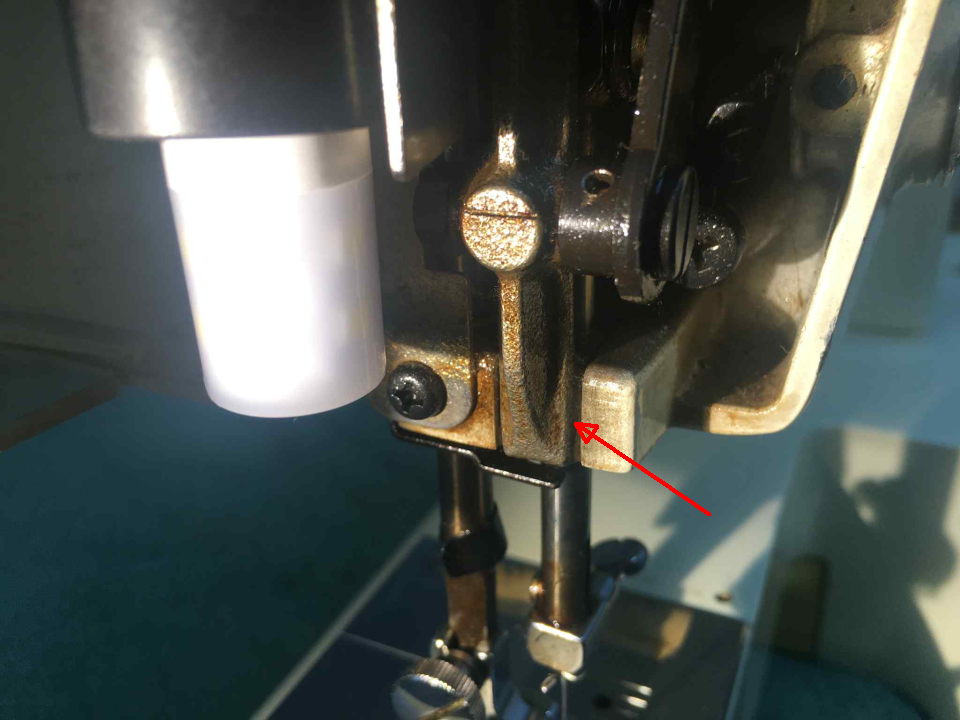
Example Service Repair:
This Frister & Rossmann Beaver 4 came in for a full service. When asked, the customer said that zigzag was not working. It was immediately clear that the machine had been oiled with motor oil - not mineral oil. All of the inside was gummed up and heavily stained. Once cleaned up, the stitching was tested and found to be stuck in straight stitch. The zigzag mechanism was locked solid! It was oiled and left overnight. Gradually the needle bar mechanism began to move left and right until it was fully free and running smoothly.
Hidden Screws
Unfortunately there is no standard approach to starting the strip down. However, it is likely that you will find most of the screws in the back casing. You may also find some under the base plate, if fitted. Once all the visible screws have been removed try moving the casing to see if anything is holding. If you are lucky you may find that one of the covers comes off relatively easily. It is very likely that it won’t, and this is when the ‘hidden screw’ hunt starts!
Starting under the needle bar cover, look for a screw holding a clip. Also look under the 'belly' of the machine to make sure there's not one just above the foot lever.
On some machines, like the 'plastic' Singers, you may find a screw holding one of the covers tucked in amongst the machine mechanism!
Neil at Sewing Machine Service Ely. (sms-ely.co.uk)
Text or WhatsApp 07702 505 703 if you have a question.
This page is at https://sms-ely.co.uk/start-sewing-machine-servicing.html
© 2024 & 07/2025 - Page by Neil Ford for Sewing Machine Service Ely, Cambridgeshire. All Rights
Reserved